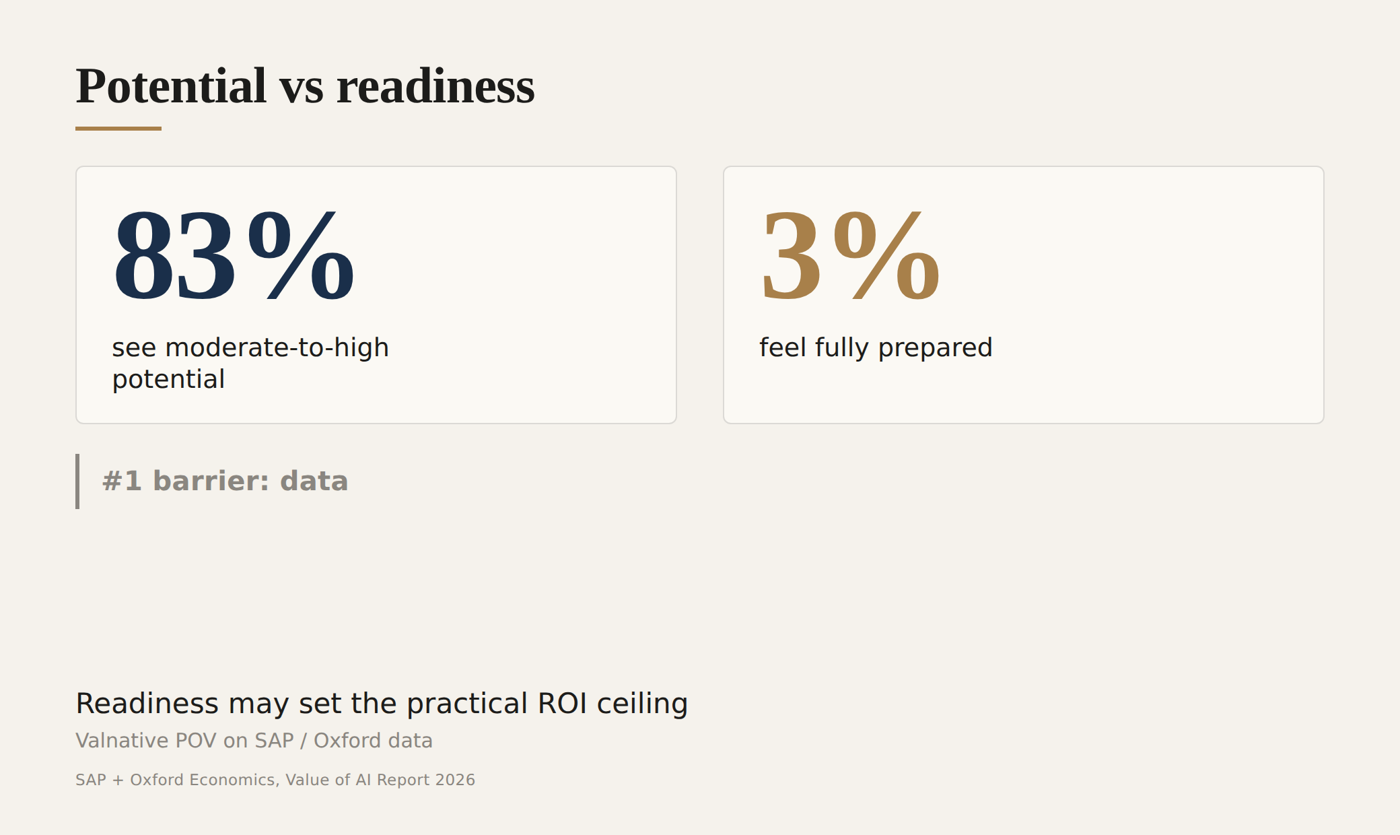
83% see the potential. 3% feel ready. Your AI ROI is capped by readiness, not the model.
For retail leaders and their data owners — stop measuring AI by adoption and spend, and start measuring it by readiness-to-decide.

Potential is universal. Readiness is rare.
There is a striking pair of numbers in SAP and Oxford Economics’ 2026 study of 2,600 leaders. Eighty-three per cent say AI has moderate-to-very-high potential to transform their organisation. Three per cent feel fully prepared for it. Almost everyone can see the destination; almost no one feels equipped to reach it.
That gap is the most important fact in enterprise AI this year, because it relocates the problem. If four in five leaders already believe in the potential, then belief is not the constraint, and neither, the study suggests, is the model. The constraint is readiness: the unglamorous state of being actually able to turn AI into value. Respondents report ROI rising for those who have it (21% this year, up from 16% last), which suggests the value is real for them. It is just landing unevenly, and it lands where readiness is, not where the biggest model is.

Data is the number-one barrier — but it is only half the ceiling
Ask leaders what stands in the way, and the same study is unambiguous: the leading barrier is data, its quality, its compliance, its reachability, ahead of skills and governance. SAP puts it plainly in its own reading: what separates the leaders is whether AI can access the data and processes it needs. A brilliant model pointed at data it cannot reach, or data too dirty to trust, produces confident nonsense. Fix the data access, and the same model suddenly earns its keep.
But data readiness, necessary as it is, is only half the ceiling, and the half everyone talks about. Clean, connected, reachable data is not value; it is raw material. It becomes value only when it turns into a decision that is actually made, allowed, executed and measured. A retailer can invest heavily in a lakehouse, connect every system, and still leave the last mile, data to decision, run by hand, in dashboards and inboxes, exactly as before. That is the quiet second barrier hiding behind the first. The data project finishes; the ROI still doesn’t land; and everyone blames the data again.
Readiness is two gears, not one
It is cleaner to think of readiness as two gears in series. The first gear is data: can the AI reach clean, connected, trustworthy data and processes. The second gear is decision: can that data be turned into a governed, explainable, completed decision, with the right method, the right authority, and a record of what happened. Motion only reaches the output when both gears engage. A retailer with a superb first gear and no second gear has spent heavily to produce better-informed inaction.
These are different disciplines, and conflating them may help explain why only 3% report feeling fully prepared. The first gear is data engineering: pipelines, quality, governance of the data estate. The second is decision intelligence, formalising the decision, keeping a human where authority requires, and completing it under a record. SHEPORD, a retail decision operating system, is designed for that second gear: the layer that takes reachable data and turns it into a governed, explainable, executed decision. It assumes the data foundation rather than replacing it (the two gears have to mesh), and it is what SHEPORD is designed to do. The ROI in this study is the market’s, reported by its respondents; it is the shape of the opportunity, not a SHEPORD outcome.
Change the metric, and the budget follows
If readiness is the ceiling, then the metrics most AI programmes track (adoption rate, number of pilots, headline spend) measure the wrong thing. They measure activity and potential. We’d propose readiness-to-decide as a more decision-useful operating metric: how much of your data can actually become a governed decision. It is a harder number to produce and a far more honest one.
Reframe the metric and the budget reallocates itself. Instead of “more AI in more functions”, the questions become: which of our decisions could be made from data we can already reach; where does the second gear (data to governed decision) not yet exist; and what would it take to close that, decision by decision. That is a smaller, sharper investment thesis than “buy more AI”.

Where this leaves you
The 2026 data settles an argument that has cost a lot of money: the thing capping AI value in retail is not the model, and increasingly it is not even the belief. It is readiness, and readiness has two gears. Get the data reachable, and then make sure the reachable data can become a governed decision, or the investment stops one gear short of the outcome. If that is the gap you recognise (the second gear more than the first), the honest next step is a conversation, and we are glad to walk through the local data-to-decision evidence behind what is claimed here.