Don't ask an LLM to make the decision. Formalize it.
For retail leaders and their data/AI owners — stop trying to make the model decide, and start formalizing the decision.

The wrong turn in the agentic story
The dominant enterprise-AI narrative of 2026 is autonomy: wrap a capable model in tools, give it a goal, and let it act. As a research direction it is exciting. As an architecture for the decisions retail actually runs on, it quietly imports a dangerous assumption: that a business decision is the kind of thing a language model should make.
Most retail operating decisions are not language problems. “Mark this line down by how much, given ending inventory, days of supply, a competitor’s clearance, and a margin floor” is a bounded optimisation under policy, not a sentence to be composed. “Replenish this SKU to this store by this quantity” is arithmetic against constraints. When you phrase such a thing as a prompt and ask a general model to answer, you are using the one tool least suited to it, and the failure mode is the worst kind.
Capgemini names it precisely in its 2026 review: “AI doesn’t fail loudly anymore. It fails convincingly.” A model asked to decide will return something fluent, confident and specific. It will look exactly like a good answer. Sometimes it is; sometimes it is off in a way that no reader can see, because nothing about the output signals the error. A wrong markdown delivered with total assurance can pass review unnoticed. That is not a bug you can prompt your way out of.

Grounding, not scale
The same review supplies the antidote, and it is not “wait for a smarter model”. In Capgemini’s Global Data Science Challenge, the winning entry reached 79.4% accuracy not by reaching for a larger model but by grounding a modest one: routing its answers through a knowledge graph with symbolic filters, so the language model handled the conversation while a structured, checkable layer handled the logic. In that challenge, grounding mattered more than model scale.
Read as a principle for decisions, that is the whole argument. Value doesn’t come from letting the model roam; it comes from giving it structure to stand on. For a retail decision, the “knowledge graph” equivalent is an explicit definition of the decision itself: the constraints, the objective, the allowed moves, the policy. Ground the decision in that, and the model has something to be right against. Leave it ungrounded, and “fails convincingly” is the default.
What it means to formalise a decision
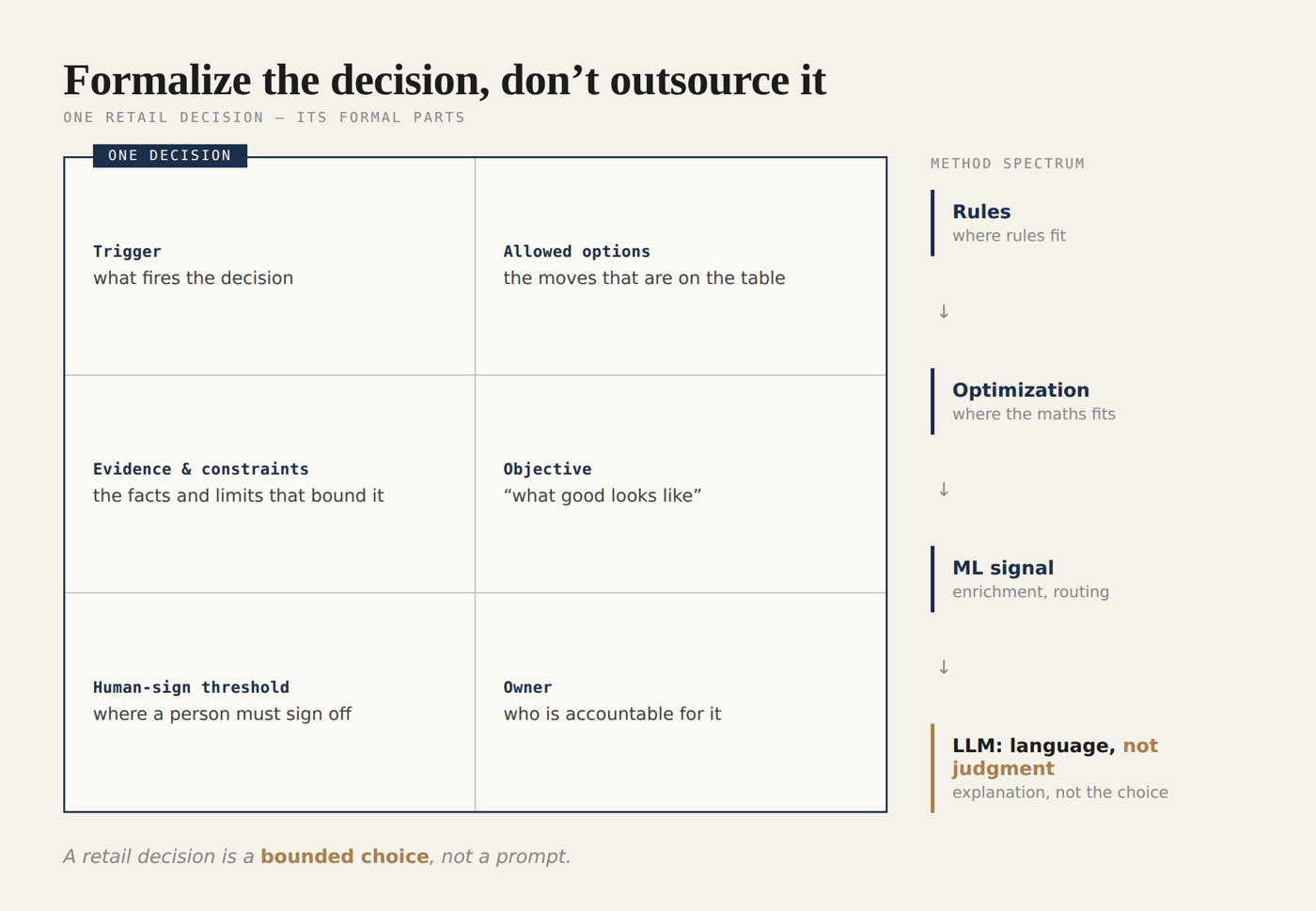
Formalising a decision is the unglamorous work the agentic hype skips. It means writing the decision down as an object with parts, rather than leaving it as tacit judgment or a prompt. In practice a formalised decision names six things: what triggers it, which options are allowed, what evidence and constraints bound it, what “good” looks like (the objective), where a human must sign (the authority threshold), and who owns it.
Once a decision has that shape, the right method for each part becomes obvious, and it is rarely “ask the LLM”. Where the logic is a policy, use rules. Where it is a trade-off under constraints, use optimisation. Where a pattern in data should inform it, use ML as a signal or a routing hint, not as the decider. And use the language model for what it is genuinely good at: turning the formalised decision and its evidence into an explanation a person can read, at the level they need. The LLM narrates and interfaces; it does not hold the judgment.
This is the architecture SHEPORD is designed around: rules enforce the policy, optimisation chooses under the constraints, ML supplies a signal, and the human keeps authority, with each decision defined once and carrying a plain-language explanation. This is what SHEPORD is designed to do, not a claim that it decides more accurately than anything else.
Why the formalised decision is the asset
There is a second reason to formalise, beyond avoiding convincing failure, and executives feel it every time an experienced operator retires. Today, a retailer’s best operating decisions often live as craft, in the heads of a handful of people who “just know” the right markdown or the right allocation. That judgment is real and valuable, and it is also a single point of failure: it doesn’t scale past those people, it can’t be examined, and it walks out of the door with them.
A formalised decision is the opposite: institutional rather than personal. Written down as a contract, it belongs to the business rather than to a person, is applied under one explicit definition wherever the decision recurs, and is governed by a named owner. And, not trivially, the model underneath it can be swapped for a better one without touching the decision itself, because the decision was never in the model. Formalising is how a retailer turns scattered tacit judgment into decision capital it actually owns.

What this means for you
The test is simple to state. Pick a decision your business makes thousands of times a week. Is it formalised (trigger, options, constraints, objective, sign-off, owner written down) or does it live in prompts and in people’s heads? Are you asking a model to decide it, and hoping the confident answer is the correct one, or is the decision grounded in structure with the model kept to language? Is the judgment institutional and governable, or personal and tacit?
If those questions land, the direction is clear: formalise the decision, ground it, keep the human where authority requires, and use the language model for language. That is a harder sell than “give the agent a goal and let it run”, and it is the one that keeps constraints, authority and evidence explicit under real P&L responsibility. If it is a gap you recognise, the honest next step is a conversation, and we are glad to walk through the local decision-formalisation and runtime evidence behind what is claimed here.