The pyramid did not disappear. We stopped seeing its base.
Which pyramid we are talking about Two structures used to sit almost exactly on top of each other, and it matters that they have come apart.
Which pyramid we are talking about
Two structures used to sit almost exactly on top of each other, and it matters that they have come apart.
The first is the hierarchy of authority: people with wide powers at the top, people carrying out instructions at the bottom.
The second is the pyramid of execution: a small volume of rare human judgement supported by a large volume of more standard work.
This is mostly about the second one.
Hierarchies can genuinely flatten. Fewer bosses, shorter approval chains, more senior individual contributors. But the need for execution does not evaporate along with the layers. Research, calculation, preparing options, checking constraints, carrying out the action: all of it still has to happen.
What has changed is that it no longer has to be bought as human time. A meaningful share of production capacity can now be configured, copied and run in parallel.
So AI does not shrink the pyramid so much as detach it from the staffing chart. To see it at all you have to count a different unit: not heads, but instances of work carried out under some rule, in a period. Headcount used to be a serviceable proxy for that number. It has stopped being one, and most organisations have not replaced it with anything.
What the old pyramid did well
Rare specialists are expensive, and not because the market is unfair. What costs money is the combination: speed, depth of domain knowledge, precision, the ability to work under ambiguity, and willingness to own the result.
Organisations worked out long ago that you cannot staff an entire company with people like that. So they learned to distribute their judgement instead.
The pyramid distributed it by seniority. Offshore distributed it by geography. Standardisation distributed it through methods and process. One principle underneath all three: do not spend an expensive expert hour on work that can be done more cheaply.
AI looks like the next entry in that list, and the mechanism underneath is different. A person has to be recruited, trained and brought into context, and each addition is a separate act of hiring. A configured piece of agentic execution can be instantiated again without repeating that act. The capacity is repeatable in a way a hire is not.
Which loosens the tie between scaling the work and scaling the payroll. That is where the restructuring starts.
Mintzberg as an X-ray
An org chart shows levels of seniority and explains almost nothing about who designs the work and who controls it.
Henry Mintzberg’s five-part model is more useful here, with one caveat stated up front: he was describing parts staffed by people, in 1980. Using it for an organisation whose operating core is partly software is our extension of the model, not his finding. It holds as a functional map of what has to happen, which is what makes it worth borrowing.
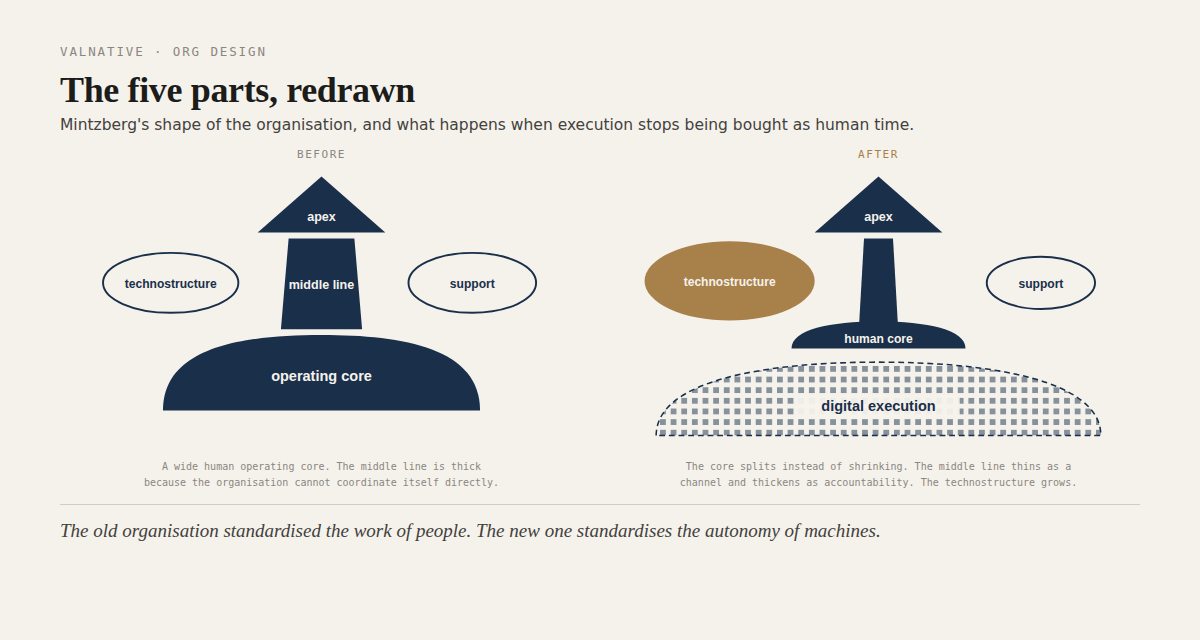
He synthesised the model in Management Science in 1980 and set it out at book length in Structure in Fives three years later, seeing an organisation as a strategic apex setting direction, a middle line of managers connecting strategy to execution, an operating core producing the actual output, a technostructure designing the processes, standards and controls, and support functions such as HR, finance, legal and IT.
Three of those five move noticeably, and they are the ones worth following: the operating core, the middle line and the technostructure. The apex and the support functions change too, in ways this piece does not try to settle.
The agent enters the operating core
Take an ordinary retail decision. Which items should be marked down, and by how much.
The old sequence: an analyst assembles sales, stock, forecast, competitor prices and margin constraints. A manager checks the calculation. A category manager picks an option. Somebody then enters the decision into a system.
Agents can now travel most of that path. Gather the data, run the forecast, generate the options, check the constraints, and carry out the action that was permitted. What is left for the person is the exceptions, the conflicts between goals, and the accountability.
That looks like the operating core shrinking. What is actually happening is that it splits in two: a wide digital core doing the standard work, and a narrower human core working on ambiguity and consequence.
People produce fewer individual recommendations by hand. They design the conditions under which the system can produce recommendations safely.
The manager stops being an information bus
Middle management existed for a long time because a large organisation could not coordinate itself directly. Managers handed out tasks, collected status, consolidated reports and moved information between levels. Agents do a good deal of that faster.
Research by Babina, Fedyk, He and Hodson on firms that invested in AI between 2010 and 2018 found them carrying fewer managerial layers and a higher share of skilled individual contributors. That is evidence about the wave before language models, let alone agents, so read it as a direction of travel and not as a forecast.
None of which means managers disappear.
What disappears is the manager as a human router: task passed down, answer collected, packet forwarded up. What remains is the manager who resolves conflicts, sets priority, allocates authority, develops people and takes escalations. The middle line gets thinner as a channel for information and more important as a layer of accountability.
The technostructure becomes the centre of gravity
The more work agents perform, the more decisions have to be made before they are allowed to run.
Which data may be used. Which method applies. What counts as a good result. When an action can be executed automatically. When a person is required. Who checks the consequences. At what deviation the process must stop.
That is technostructure work: architects, method owners, data and process owners, and the people responsible for evals, governance, policy, security and observability.
The old organisation standardised the work of people. The new one standardises the autonomy of machines.
So AI can reduce the number of people executing while increasing the volume of organisational design and control. Read onto Mintzberg’s diagram, the human base contracts while the technostructure wing expands and moves toward the centre. That is the lens we would use, offered as a way of seeing the change rather than as a measured account of where every organisation has ended up.
One firm’s organisational choice is worth putting on the table, without asking it to carry more than it can. Accenture named client-facing Reinvention Partners alongside three Reinvention Engines covering AI and Data, Industry and Process, and Technology, with integrated delivery governance and quality standing as a separate function beside them. One company does not establish a trend, and nothing here should be read as evidence of one. What it is, is a professional services firm choosing to name and staff the layer that owns methods, platforms and standardisation as a first-class part of its structure.
And as the technostructure gains weight, it also concentrates risk.
If a single system detects a problem, selects the method, computes the answer, executes it and then confirms its own success, the organisation has not acquired autonomy. It has acquired self-certifying authority.
Which is why computation, permission, execution and verification have to sit in different hands, even when all four are done with AI.
What the shape looks like now
Draw only the employees and the organisation really does get smaller and flatter. Fewer junior executors. Fewer managers whose job was moving information. More senior individual contributors. A stronger layer designing methods and controls. A small strategic apex.
That is not a classical pyramid. It is closer to a narrow human tower.
Underneath it sits a wide digital base: agents, models, workflows, rules, memory and execution systems.
Two structures now overlap. The first is a human hierarchy of accountability, and it is comparatively narrow. The second is an execution architecture, and it is wide, dynamic and mostly digital.
AI does not flatten the organisation. It separates whoever performs the work from whoever is entitled to set its goals and answer for what follows.
The unit of efficiency has to change
When an agent finishes in minutes, it is easy to assume productivity has already turned into savings. A cheap result is not the same thing as a cheap operation, and the cost tends to come back somewhere less visible: in checking the output, in handling exceptions, in unwinding consequences, in monitoring, in maintaining context and rules, and in reconstructing why the system decided what it decided.
Seniority and offshore rates were visible in the estimate before the engagement started. Verification and escaped errors usually become visible after go-live.
Which means the measure of efficiency can no longer be volume of generated output, and cannot really be time saved either.
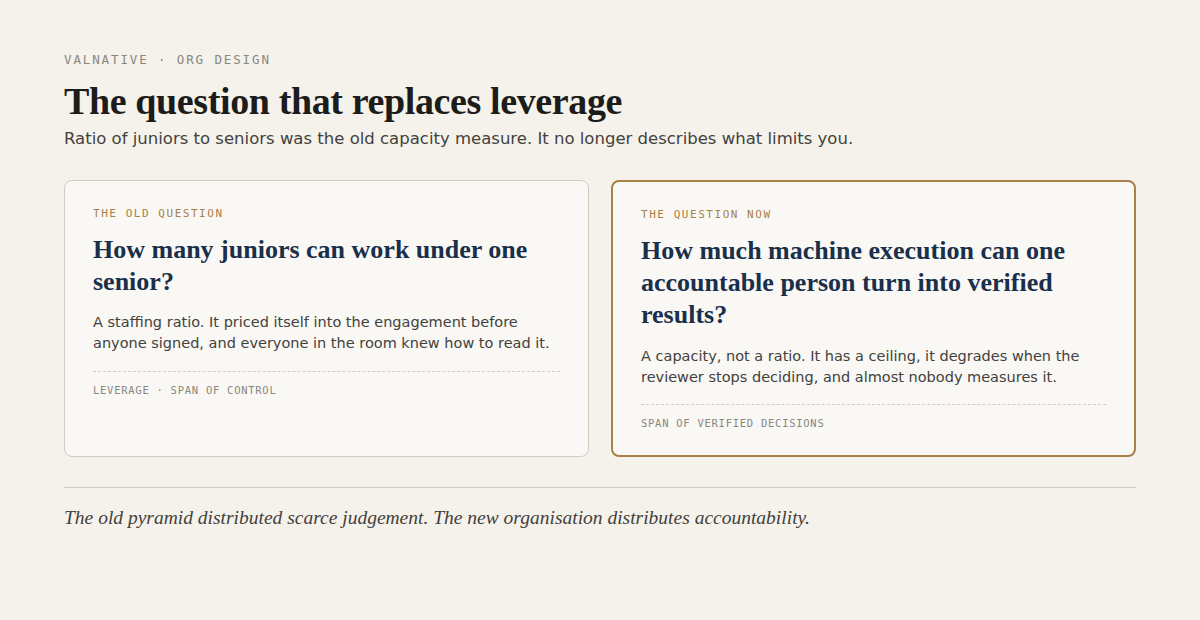
The old pyramid asked how many juniors can work under one senior.
The useful question now is how much machine execution one accountable person can carry to a verified outcome while still genuinely answering for it.
We call that the span of verified decisions, and it is our term rather than an established one. To be a number instead of a slogan it needs four things stated: the decision class it applies to, since markdowns and supplier exits are not interchangeable; the period it is measured over; what verification means here, meaning someone can reconstruct why the decision was made and confirm the effect landed in the system of record; and how failures count, including the ones caught late and the ones rolled back.
It measures control capacity rather than productivity, which is the point. Capacity to produce is no longer the binding constraint.
Removing junior work removes something else
The old pyramid had a second function that nobody wrote down: it manufactured the next generation of experts.
The analyst learned to assemble data. The consultant learned to build the model. The manager learned to spot the error. The partner learned to decide and to face the client.
If an agent performs the junior work from the start, the firm gets productivity now and may lose the mechanism that produced professional judgement later.
Stanford’s Digital Economy Lab reported a 16% relative decline in employment among workers aged 22 to 25 in the most AI-exposed occupations, while more experienced workers in those same occupations held steady or improved. The figure was 13% when the work first appeared in August 2025 and was revised upward that November, which is worth knowing before anyone quotes it. The authors are explicit that they do not claim the effect is fully driven by AI, since a great deal else changed in the US economy over the same period. Other credible work reaches different conclusions. Research from the NBER and the Atlanta Fed surveying corporate executives found reallocation across roles rather than aggregate decline, and a 2026 survey of UK employers found most expecting entry-level work to be reshaped and few expecting roles to be replaced. Those studies measure different populations and different outcomes, so they cannot be scored against each other. The honest position is that the question is open. But the structural risk stands on its own logic. AI can remove the lower rungs faster than an organisation builds a new route upward.
A firm that automates junior work has to design apprenticeship deliberately: decide first and compare with the agent afterwards, work through the errors and the exceptions, run shadow decisions, widen authority in steps, and check periodically that people can still judge without the system.
Skip that and the saving on junior positions carries a risk worth naming: experience debt, where an organisation ends up with plenty of agents and too few people who have built the judgement to check them. Whether it materialises depends on what gets put in place of the old apprenticeship, which is precisely why it is worth deciding on purpose rather than by default.
This structure needs different management, not less of it
The organisation ahead is not flat.
It carries fewer layers whose purpose is passing instructions down and collecting status upward. It carries more explicitly designed layers owning data, methods, decision rights, control and proof of outcome.
That is why we separate those powers across the portfolio rather than bundling them. DecidRA is designed to notice a deviation and put forward candidate actions. BoardRA is designed for the prior question of how a class of decisions should be made at all. SHEPORD is designed to decide and to authorise, holding the evidence and the trace of why. Operstead is our execution harness, designed to carry out only what was authorised and to return a receipt from the system whose state was supposed to change.
No single layer should compute a decision, approve it, execute it and then declare itself successful.
The old pyramid distributed a scarcity of human judgement across many cheap hours.
The new organisation distributes human accountability across an enormous volume of machine execution.
The pyramid did not disappear. It changed material, it changed its centre of gravity, and it changed what keeps it standing.