The triangle did not disappear. It moved.
Why rare people are expensive, stated properly The usual explanation is that talent is scarce.

Why rare people are expensive, stated properly
The usual explanation is that talent is scarce. That is true and not very useful, because it does not say what is scarce.
What is scarce is the combination, and the reason is structural before it is statistical. A group meeting four requirements at once is never larger than the group meeting the hardest one, and is normally a great deal smaller. As an illustration only: if each of four qualities described one person in ten and the four were independent, the intersection would be one in ten thousand. Treat that as a picture of the shape, not as a measurement. The joint distribution is not independent, and nobody has measured it.
What is worth knowing is which way the error runs, because it runs against you. Take the usual wish list: fast, precise, genuinely good at judgement, inexpensive. The first three plausibly travel together, which makes the intersection larger than the toy arithmetic suggests. The fourth is not a quality at all. Being inexpensive is the market’s verdict on how rare the first three are. Asking for all four is asking the labour market to have mispriced somebody. That does happen. It is not a staffing model.
So organisations stopped trying to buy the intersection and built structures to avoid needing it.
The pyramid and the offshore contract are the same idea
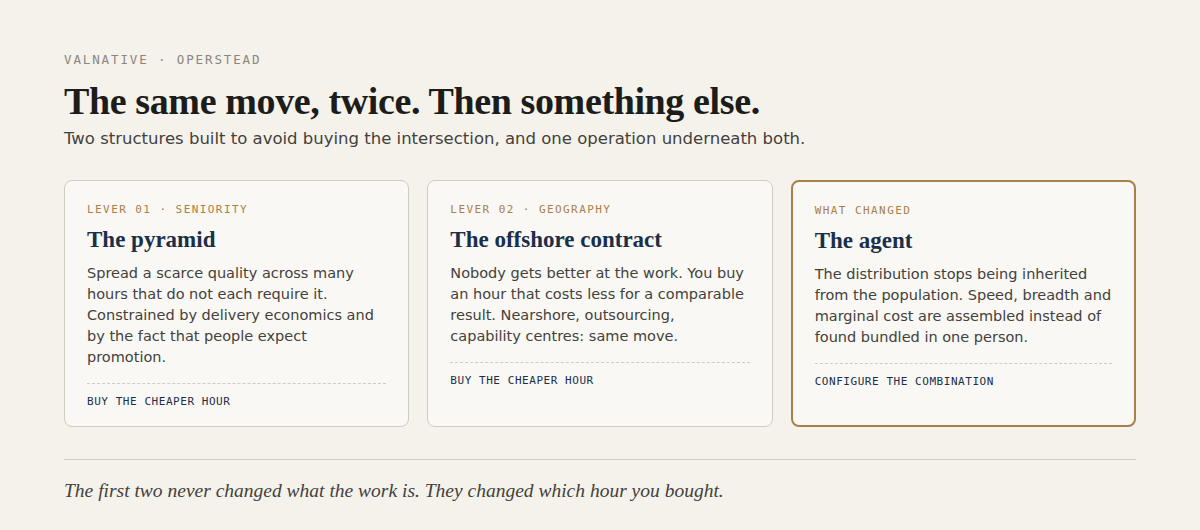
David Maister set out the economics of the first structure in Balancing the Professional Service Firm in 1982, and at book length in 1993. Leverage, the ratio of junior to mid-level to senior staff, is the central management variable of a professional firm. It is constrained from two directions at once: by the economics of what the work costs to deliver, and by the fact that people expect to be promoted. The pyramid is a mechanism for spreading a scarce quality across many hours that do not individually require it, which is a different thing from a device for billing more.
Offshore delivery does the same thing along a different dimension. It does not make anyone better at the work. It buys an hour that costs less while producing a comparable result. Global capability centres, nearshore, outsourcing: the vocabulary changes, the move does not.
So the entire history of cost management in knowledge work comes down to one operation, performed twice. Find the cheaper hour. Nobody was ever changing the nature of the work. Everybody was changing which hour they bought.
What agents actually change
This is the part that is genuinely new, and it is worth stating precisely, because the imprecise version is what causes the disappointment later.
Every previous lever took the distribution of human ability as a given. You could not order more senior people into existence. You could only arrange the ones that exist more cleverly, or find them somewhere cheaper. The distribution was inherited from the population, and no amount of management changed it.
An agent is configured, not recruited. Speed, breadth, tirelessness and marginal cost stop being properties you have to find bundled in a person and become properties you assemble. The intersection you could not hire is no longer something you have to search for. That is a real change, and it is the reason the old triangle feels as though it has dissolved.
It has not dissolved. Watch where the cost reappears.
The output looks best exactly where you inspect it
New Relic’s 2026 State of AI Coding, a survey it commissioned from Hanover Research covering 200 US decision-makers at companies already running AI in engineering, reports something that should stop any buyer mid sentence.
Ninety four percent of those leaders rate AI-generated code as higher quality than human-authored code at the time of review. The same population reports that 78% see more incidents, that 82% had at least one production failure tied to AI-generated code in the prior six months, that 74% say at least a quarter of AI code needs significant rework, and that 86% see senior staff spending more time fixing code.
These are perceptions rather than telemetry, and the sponsor sells tooling for precisely the failure this describes, so treat the levels with the caution that deserves. Note also what the survey does not do: it does not follow particular pieces of code from review into production, so it reports what one population believes about two different stages, not a tracked outcome for the same artefact.
Even read that carefully, the tension is the interesting part, and it does not depend on the exact percentages. The same people who rate the output well at review are the people reporting more of it failing later. One explanation is that review is not merely a weak control but an actively misleading one, because fluent, well-structured, confident output is what a reviewer scores highly and also what hides a defect until production. That is a hypothesis, and confirming it needs artefact-level data nobody has published. It is, however, the explanation a buyer should price for, because it is the expensive one.
On that reading the cheapness was never removed. It moved to a later date and a different budget line.
Speed does not convert into savings at par
The second place the cost reappears is more subtle. A June 2026 study of agent use, written by Jeremy Yang, Kate Zyskowski, Noah Yonack and Jerry Ma and based on production telemetry from Perplexity’s own products, matched roughly ten thousand session pairs across a hundred thousand sampled queries between late February and late May 2026.
On matched tasks, completion time fell from 269 minutes to 36, which the authors put at an 87% reduction. Read the baseline before you use the number: the comparison is against people working with search, not people working unaided, and three of the four authors are affiliated with the vendor whose products supply both the data and the definition of the baseline. The paper is a preprint and has not been peer reviewed.
The finding that survives all of that is the one about where the gains go. Reductions in execution time do not pass through into proportional gains downstream, because coordination and verification absorb them. And on their cost model, agent delegation is not always the cheaper route: below a certain number of steps, the fixed cost of delegating and then checking the result dominates, and the conversational mode wins.
Their own framing of the breakeven is worth quoting for what it does not say. On their assumed wage rates and human-equivalent time estimates, a professional would need to run every command, edit every file and navigate every application in under twenty minutes to match the agent route on total cost. That is a cost-indifference point computed from their assumed wage rates and their own estimates of human-equivalent time, not a measured law of nature, and it moves as soon as your rates or your task mix differ from theirs. Taken for what it is, it still says something useful: there exists a task length below which delegation stops paying, and being under it is a property of the work rather than a sign that you configured something badly. Where your own threshold sits is an arithmetic question you can answer with your own numbers.
The new axes
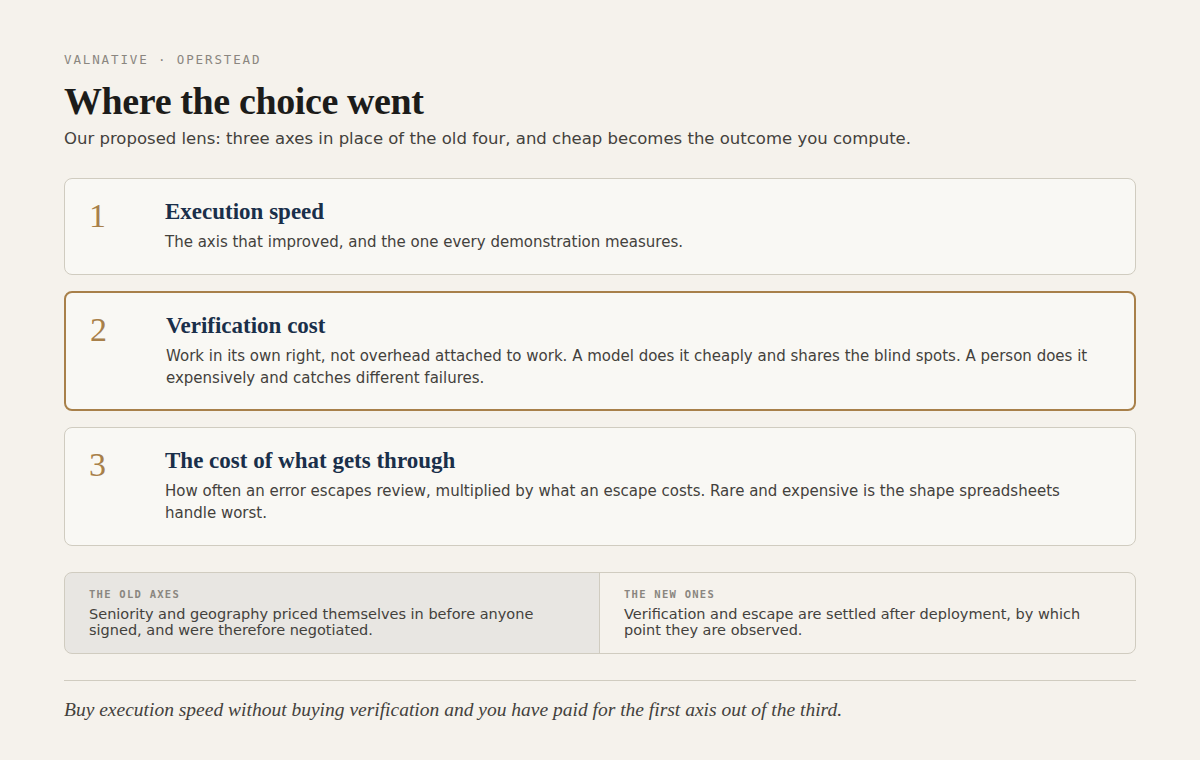
Put the two together and a working lens falls out. This is our proposed way of pricing the decision, not a finding either study makes: three axes in place of the old four desiderata, with fast and capable collapsing into the first, accurate splitting across the second and third, and cheap becoming the outcome you compute rather than an input you demand.
Execution speed is the axis these studies show improving, and the one every demonstration measures.
Verification cost is the axis that gets budgeted least. It is not overhead attached to the work. It is work, and its price is set by how much of it a model can do (cheap, and blind in the same places as the thing it is checking) versus how much a person must do (expensive, catching different failures, and taken from someone whose time has other claims on it).
The cost of what gets through is the axis that decides whether the first two mattered. Its expected value is how often an error escapes multiplied by what an escape costs, and its shape, rare and expensive, is the one that survives contact with a spreadsheet least well.
Choosing is not optional on these axes any more than it was on the old ones. Buy execution speed without buying verification and you have paid for the first axis out of the third.
None of these costs is new. Human delivery always carried review and always let errors through, and any partner who has written off a project knows exactly what an escape costs. What changes is proportion and timing. Seniority and geography priced themselves into the contract before anyone signed it, and were therefore negotiated. Verification and escape are settled after deployment, by which point they are observed, not agreed.
What the reshaping actually looks like
One firm with heavy exposure is worth a look, not because it settles anything but because its numbers are on the record. In its third quarter of fiscal 2026 Accenture reported approximately 799,000 people and around 124,000 promotions across the fiscal year, an increase of 30% on the prior year, alongside the chief executive describing a shift toward non-FTE commercial models over time.
Read that carefully rather than triumphantly. It is one firm and not a market, the promotion figure covers a fiscal year and not a quarter, and the pricing comment is hedged and attached to specific acquisitions, so it does not describe how the business as a whole is sold. What it shows is a firm adding commercial models that are not priced per head while continuing to promote heavily. That is compatible with a pyramid being rebuilt upward. It is also compatible with several other stories, and one company’s quarter cannot distinguish between them.
On whether the junior tier is disappearing more broadly, the honest answer is that the evidence does not agree with itself, and anyone telling you otherwise is selecting. Stanford’s Digital Economy Lab found a decline in employment for workers aged 22 to 25 in the most AI-exposed occupations. Work from the NBER and the Atlanta Fed surveying corporate executives found reallocation instead of aggregate decline. A survey of UK employers found most expecting entry-level work to be reshaped and few expecting roles to be replaced. These are not three answers to one question. They measure different populations and different outcomes: realised employment among young workers, executives’ aggregate expectations, and employers’ predictions about entry-level roles. Counting them against each other would be a mistake, and so would picking whichever fits your argument. On present evidence the question is open.
What to do with this on Monday
Two things, both cheap.
Find your own threshold before delegating by default. The twenty minute figure above belongs to somebody else’s wage assumptions, but the shape holds: below some task length, the fixed cost of delegating and then checking eats the gain. Work out where that line sits on your rates, then keep short work with the person who can just do it.
Then price a real process on all three axes, not one. Take something you are running now and put numbers to it: what one attempt costs, how many attempts it takes to reach something usable, what verification costs in tokens and in reviewer hours, and what one escaped error costs multiplied by how often you think escape happens. The first number is the one on the vendor’s chart. The other three are the reason the chart keeps mispredicting the invoice.
We build Operstead, our execution harness for agent work, around that second axis. It is designed so that a run is durable, so that a retry is not a second order, and so that an authorised action returns a receipt from the system it was supposed to change. None of that makes verification free. It is designed to make the cost of verification visible enough to price, which is the part that keeps disappearing.
The choice was never removed. It was relocated, from a negotiation you have before the work to an invoice you receive after it.