Reliable enterprise AI is a closed loop, not a shopping list
For leaders scaling AI — stop scoring maturity by tool count and start scoring it by loop closure.
The reliability question, asked the wrong way
When an AI pilot behaves badly, the usual reflex is to shop. A better catalogue, another guardrail product, a fresher agent framework. Each purchase helps a little and none of them fixes the thing that actually broke, because the problem was rarely a missing tool. It was a missing connection between the tools you already had.
Reliable enterprise AI is an architecture, and architectures are built, not bought. What makes an agent trustworthy is the context around it, more than the model behind it: does it know what a term means in your business, what it is allowed to do, and what happened last time someone did it. Supply that, and a modest model behaves. Withhold it, and the best model on the market will guess with total confidence.
Two flows, and why both are needed
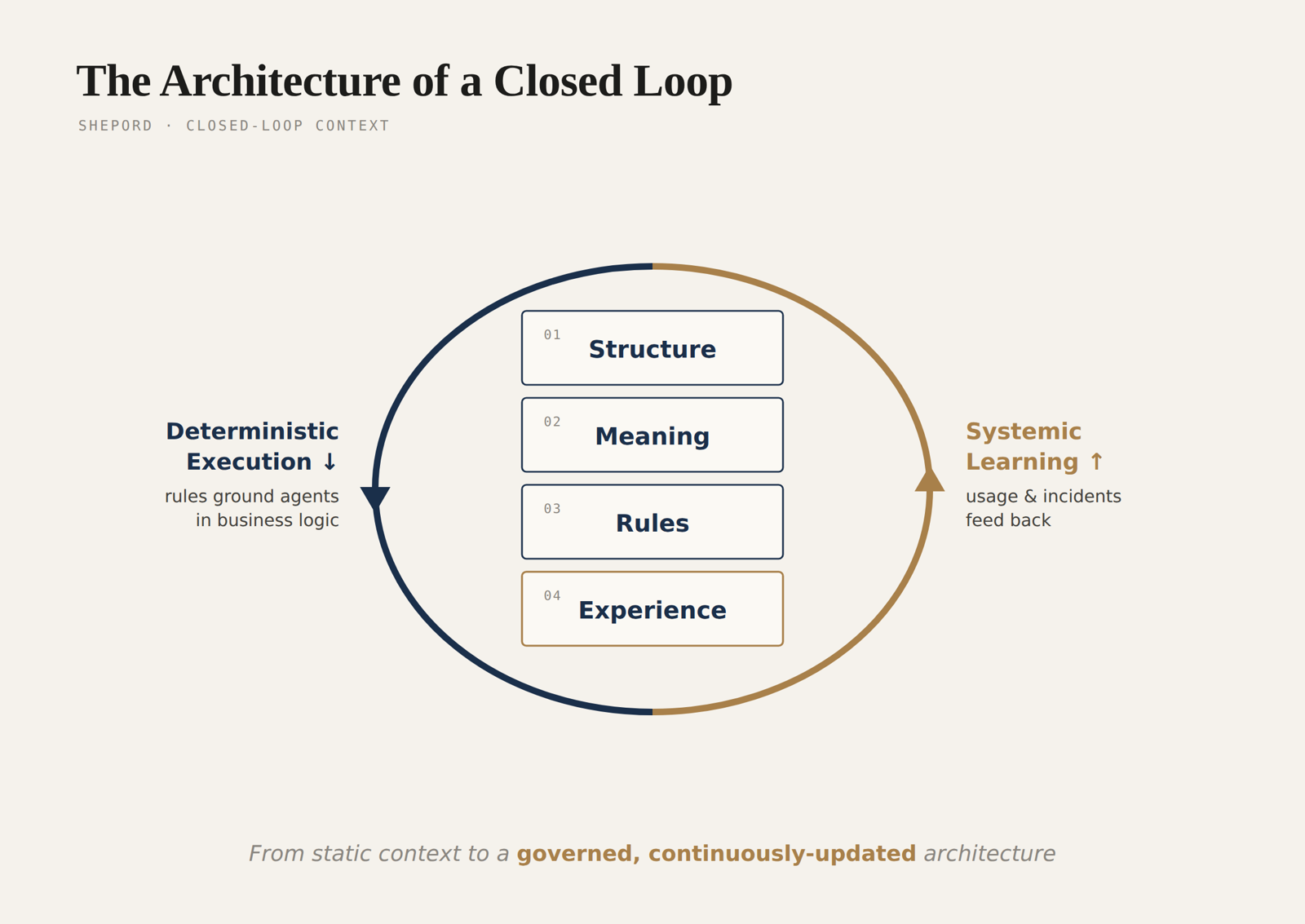
The architecture has a direction, and in fact it has two.
The first runs top-down and it is deterministic. Structural, semantic and procedural rules — the physical schema, the business meaning, the SOPs and policies — sit above the agent and ground it in real logic. This is the flow that lets an agent act on “mark this line down within the margin floor” rather than an eloquent paraphrase of it. Done well, it is what grounds the agent against hallucination and helps keep its actions inside policy.
The second runs bottom-up and it is about learning. Real behaviour, execution logs and the root-cause analyses of things that went wrong flow back into the system. Trust scores get updated. A canonical definition gets corrected. A semantic model absorbs how people actually ask. Nothing here is exotic; it is simply the estate paying attention to itself.
Keep only the first flow and you get a rigid system that never improves. Keep only the second and you get a system that learns fast and acts unsafely. Put them together and something changes character. Enterprise knowledge stops being a static asset that decays and starts being a loop that compounds.
The framework: coverage across two axes
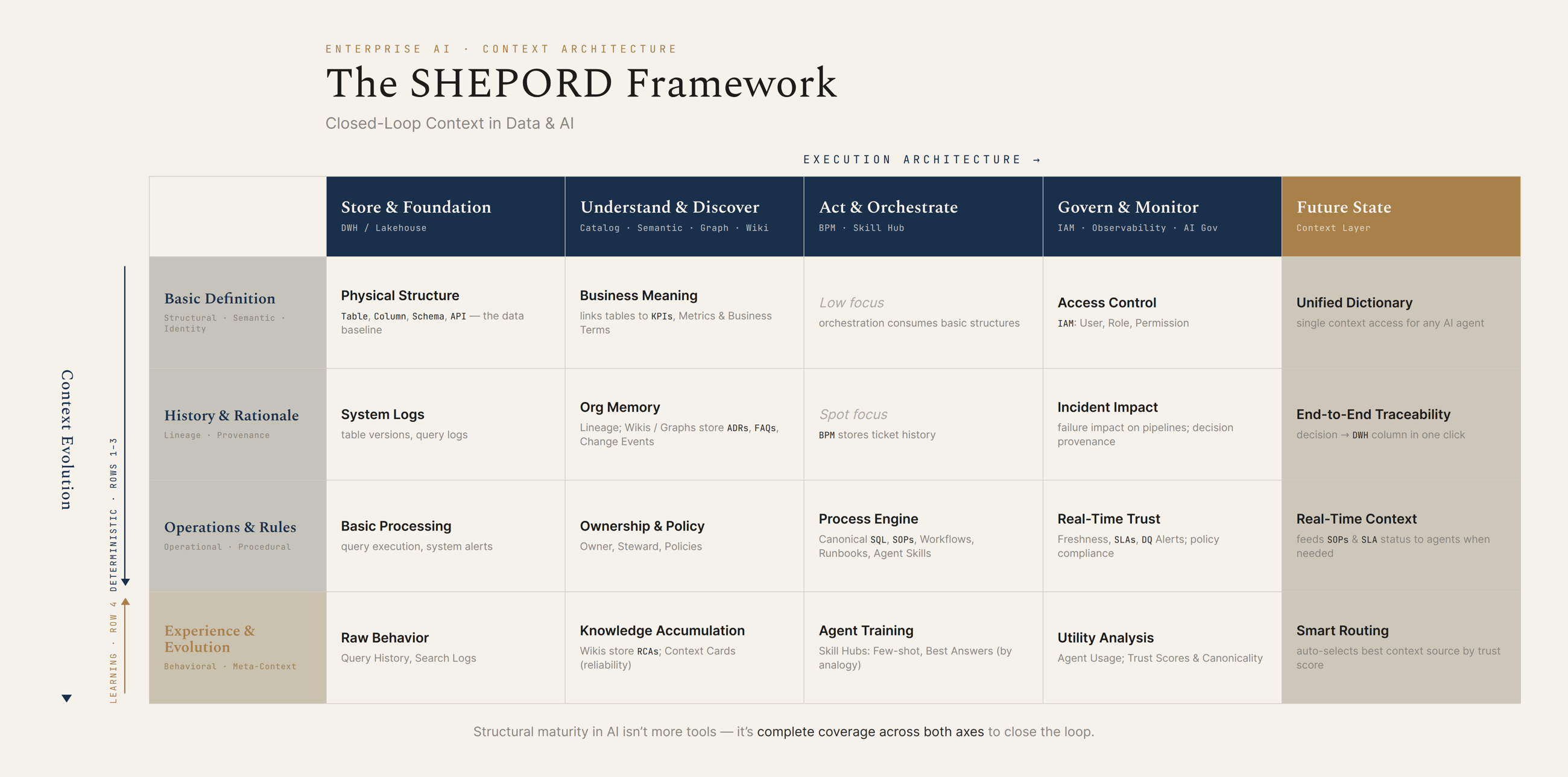
That loop is easier to manage when you can see it, which is what the SHEPORD framework is for. It sets one axis against the other. Context Evolution runs from basic definition, through history and rationale, through operations and rules, to experience and evolution. Execution Architecture runs from store and foundation, through understand and discover, through act and orchestrate, through govern and monitor, to the context layer that feeds all of it back to the agent.
Read the grid and every cell has a job. Some cells ground an action: a business term linked to a metric, a policy attached to an owner, an SLA fed to an agent at the moment it acts. Other cells learn from an action: a query log that shows how people search, an incident write-up that lowers a trust score, a usage pattern that reveals which context source to trust next time. The matrix below is the whole map on one page.
The gaps are where reliability leaks
The reason to draw the grid is to find where it is empty. A retailer might have a superb store-and-foundation column and almost nothing under govern-and-monitor, which means agents act on clean data with no trust signal and no learning. Another might have rich definitions but no context layer, so all that meaning never reaches the agent at the moment of the decision. Each empty cell is an unguarded seam, and reliability leaks out of seams long before it fails in the open.
This is also why “are we mature with AI” is usually answered wrong. Maturity gets scored by how many capable tools are in the stack. The grid scores it differently: by how much of both axes is actually covered, and whether the coverage joins up into a closed loop. A stack of excellent, disconnected tools is a low-maturity architecture wearing an expensive coat.
SHEPORD is this framework and the architecture it points to: a way to design the loop deliberately rather than assemble it by accident.
What this changes for you
The first move is to stop shopping and start mapping. Put your own estate on the two axes and mark what is covered, what is thin, and what is missing. The second is to change the question you ask about maturity, from “which tools do we run” to “is the loop closed”. The third follows on its own: fill the gaps that break the loop first, because those are the ones leaking reliability today.
None of this is a purchase you can approve in an afternoon. It is a build, with a shape. But the shape is knowable, and once the loop is closed the architecture is designed to do something a growing tool list does not: improve from its own use, through the feedback each run produces.
Where this leaves you
Adding tools makes an estate bigger. Closing the loop is the part designed to make it reliable and, over time, to keep improving from how it is used. The organisations that get there are not the ones with the longest tool list; they are the ones whose context grounds every action and whose every action teaches the context something back. If the gaps in your own grid are the thing you keep tripping over, that is the conversation worth having, and we are glad to walk the framework against your estate.