The retail AI prize is on the shelf, not at the storefront.
For retail chain and FMCG supplier executives: (1) retail's AI divide is not a technology-access gap, most of the same tools are available to slow and fast movers alike; it is an investment-priority gap between where attention goes (customer-facing layers still 'too early to tell' on value) and wher

Two speeds, one industry
Every retail AI conversation this year opens with the same reassurance: adoption is high, nearly everyone has something running. BCG’s June 2026 board brief with the Consumer Goods Forum, based on a survey of 39 CPG and retail executives conducted in April 2026, complicates that comfort. Retail, it finds, is running at two distinct speeds. 45% of retailers are scaling AI value across their operations, while 40% have barely started. That is not a gentle spread around an average, it is a split industry, and the executives on the slower side are not necessarily behind on technology access: most of the same tools and vendors are available to everyone in the sample.
Our read of the brief is that the two groups differ less in effort than in where that effort is aimed. The scaling group has pushed AI into the recurring operating decisions that run the business day to day. The group that has barely started is still concentrated on visible, customer-facing work: personalization pilots, conversational shopping assistants, and the emerging attention around AI search visibility and agentic commerce, all of which the same brief calls promising but explicitly too early to size on value. Two speeds, one industry. The brief reports the split and the value pools; reading the split as a consequence of where investment goes is our interpretation, not its finding.
Where the attention goes, and where the value pools
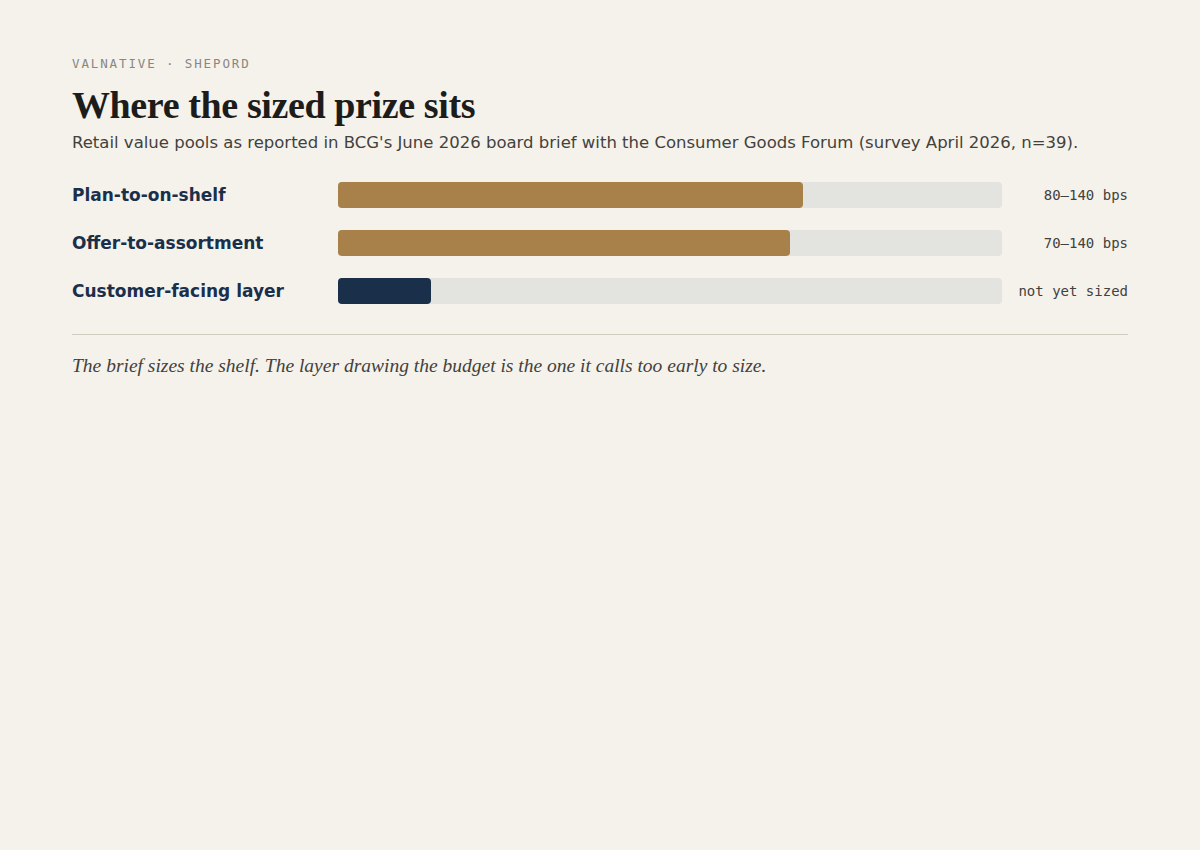
Ask a retail or CPG executive where AI creates value this year, and the first honest answer, before evidence enters the room, is usually the customer interface: recommendation engines, chat-based shopping, agentic commerce, brand visibility inside AI search results. The board brief does not dismiss any of that as unimportant. It says the newer customer-facing layer is still an open question, too early to size, while the largest, already-quantified value pools sit somewhere less visible.
The brief’s Exhibit 3 puts numbers on that gap for retail specifically. Offer-to-assortment decisions, what to carry and where, are worth an estimated 70 to 140 basis points of EBIT at full scale. Plan-to-on-shelf execution, keeping the right product physically available and priced correctly, adds another 80 to 140 basis points. Combined with adjacent processes, the brief estimates the full retail prize at 180 to 360 basis points of EBIT once AI is scaled across the operation. On the CPG side of the same value chain, the brief finds a comparable pool inside partner-to-sell processes, 110 to 160 basis points, so suppliers reading this are not exempt from the same pattern. These are BCG’s market-level estimates from a 39-executive survey, not a claim about any single company’s results, and they describe process value rather than a guaranteed outcome for any given retailer or supplier.

The strategy-deployment gap
The board brief’s most uncomfortable finding is not the value pool itself, it is the gap between what executives call strategic and where they have actually deployed AI. In the same survey, 46% of retail executives name offer-to-assortment as among their most strategic processes. Only 34% report having scaled AI into it. The words and the budget do not agree with each other, and that gap is a reasonable proxy for where the two speeds diverge: the scaling half of the industry appears to be closing it, while the slower half keeps naming the process as important while investing attention elsewhere.
This is not a claim that assortment work is being ignored across the industry. It is a claim, grounded in the same 39-executive sample, that it is under-resourced relative to how strategic executives themselves say it is. A board that calls assortment strategic in its planning documents and then funds a conversational pilot ahead of it is making an implicit bet that the visible, customer-facing project will move the number more than the invisible operating decision will. The brief’s own value pools suggest that bet is, on the evidence available, backwards.
Volume is what rules the conversational interface out
A second gap runs underneath the first, and it explains why assortment and shelf decisions resist the tools that work well in customer-facing settings. A conversational interface fits work where a person weighs each answer and nothing happens without them. Assortment and on-shelf decisions do not tolerate that pattern at the volume retail runs them.
A chain does not have the staff to route every replenishment call, every markdown depth and every local assortment swap through a one-at-a-time dialogue. The frequency is too high and the value decays too fast, by the hour in the case of a markdown. So the question stops being which interface surfaces the answer and becomes which of these decisions may run inside a guardrail, which must stop for a named approver, and how that boundary is defined and enforced. That is a different kind of system from a chat window, and it is the one these decisions need.

What a governed shelf decision requires
If the prize sits inside offer-to-assortment and plan-to-on-shelf decisions, and the obstacle is governing autopilot at high frequency rather than adding another conversational layer, the design implication follows directly. Retailers need a system built around the decision itself, not around a dialogue.
SHEPORD is designed as exactly that: a contract-driven retail decision operating system built to run recurring operating decisions, including assortment and shelf calls, under explicit governance rather than through an open-ended chat interface. As designed, each recurring decision type is defined as a contract: what triggers it, what evidence it must weigh, and what range of actions is permitted. Reversible, in-policy calls, a like-for-like replenishment inside a known band, are designed to proceed and post a receipt. Calls that carry real authority, a markdown beyond a set depth, a permanent assortment delist, are designed to stop for a named owner before anything happens. Every decision is designed to carry its own trace: the evidence considered, the options weighed, and the outcome, so the reasoning behind an assortment call is captured rather than left in a manager’s head.
None of this is a claim that a chat interface has no place in retail. It is a claim that the highest-value processes the board brief identifies, offer-to-assortment and plan-to-on-shelf, are high-frequency, evidence-heavy and authority-sensitive, which makes them a governance problem before they are an interface problem.
What changes for the executive
For a retail or FMCG executive reading the same board brief, the practical question is not whether to invest in AI, most already have. It is where the next unit of that investment goes. Three questions are worth putting to your own leadership team directly. Which of our recurring assortment and shelf decisions are we actually trying to scale AI into, versus name as strategic in a planning deck? Of those decisions, how many run today as copilot only, with a person reviewing every single call, and which have volume and value decay that make copilot unsustainable at scale? And where a decision carries real authority, a delist, a deep markdown, a supplier reallocation, who is the named approver, and is that boundary written down anywhere a system can enforce it?
The board brief’s own arithmetic suggests the answer to the first question is usually assortment and shelf work, not the newer customer-facing layer competing for the same budget line. Reallocating investment priority toward the decisions the brief already sizes, rather than the ones drawing attention, is the more defensible read of the evidence executives already have in hand.
Where this leaves you
Retail is not short on AI activity. It is short on AI aimed at the decisions the evidence says are worth the most: what to carry, and how to keep it on the shelf, decided fast, governed properly, and remembered the next time the same call comes around. The industry’s two speeds look less like a technology gap than a question of where the investment points. The brief supplies the value pools; deciding that your own next unit of spend belongs behind the shelf is a judgement it can inform but not make for you.
If offer-to-assortment and plan-to-on-shelf decisions are where your own organization’s attention has not yet gone, that is worth a direct conversation rather than another pilot slide. We are open to design-partner discussions with retail and FMCG teams working on exactly this shift.