Your forecast isn't the bottleneck anymore. Your decision loop is.
For retail / FMCG / logistics executives — stop buying prediction and start owning the decision loop.

Adoption was the last battle. Value is this one.
For a decade, the retail data agenda had a clear enemy: uncertainty. Nobody could see demand clearly enough, so everyone invested in seeing it better: data lakes, demand sensing, machine-learning forecasts. It largely worked, and AI has since spread into almost every corner of the operation. Seeing demand is no longer the scarce thing it was.
And yet the value isn’t showing up where it counts. The symptoms that justified all the investment are still here: shelves go empty while the system says “in stock”, markdowns fire late and blunt, exception alerts pile up faster than anyone can clear them. If seeing demand were the binding constraint, near-universal AI would have dissolved these problems. It hasn’t, which means the constraint sits somewhere else.
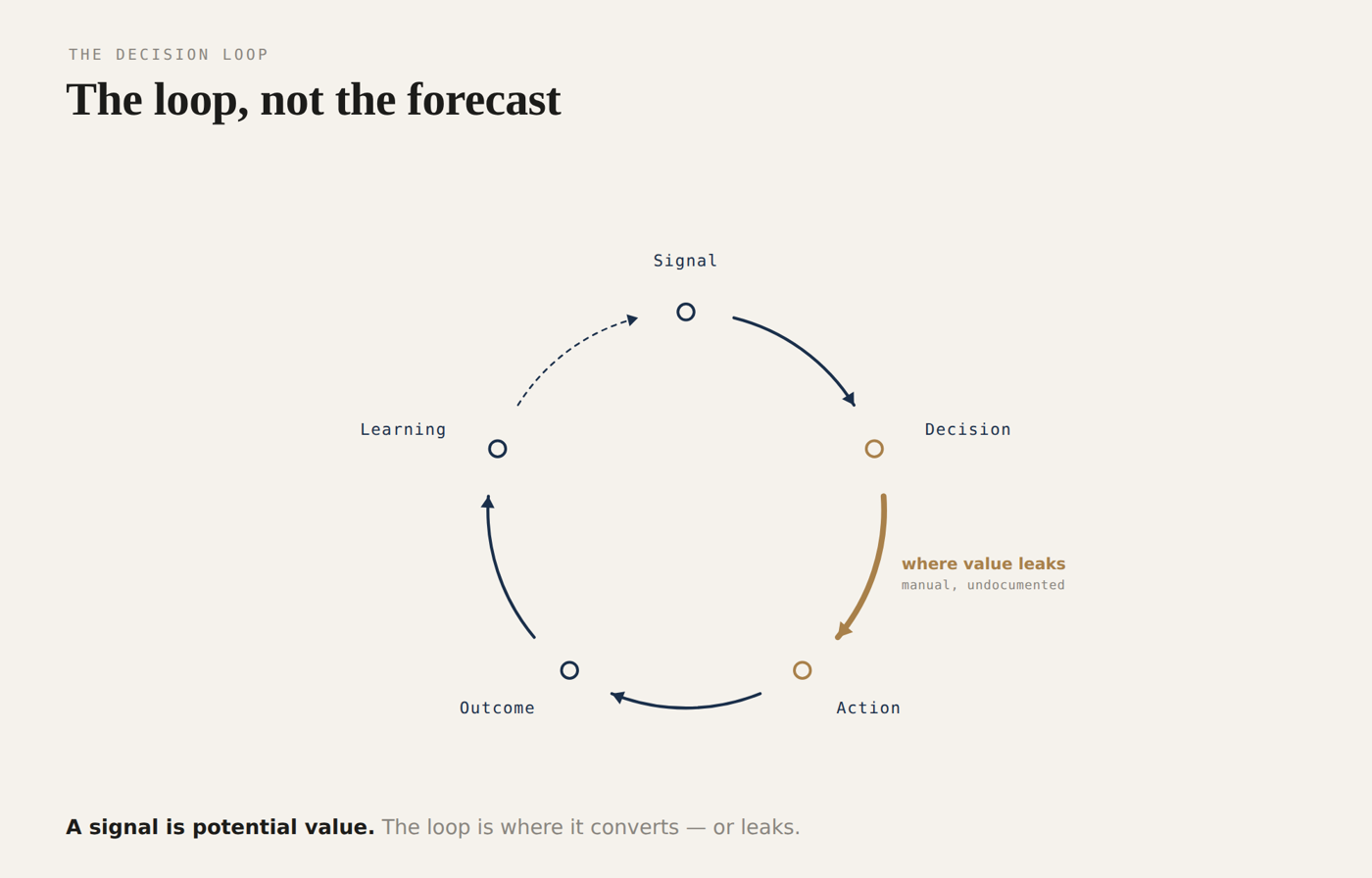
Capgemini put it plainly in its 2026 Data-powered Innovation Review: “The bottleneck stopped being prediction years ago. The bottleneck is the gap between knowing and doing.” You can watch AI surface the signal in almost every retailer now; what you can’t watch is that signal reliably becoming a governed decision, a completed action, and a captured outcome. Knowing that a store will stock out on Thursday is worth nothing until someone decides what to do, is allowed to do it, does it, and finds out whether it worked. That is not an adoption problem. It is a decision-loop problem.

Why retail’s decision loop is the hard one
Every business has a gap between knowing and doing. Retail’s is unusually punishing, for four reasons that compound.
It is high-frequency. A single chain runs an enormous volume of small operating decisions every week: replenish this SKU to that store, mark this line down, hold that promotion, reroute that pallet. No committee cadence survives contact with that volume; most of these decisions are made in seconds, by people or scripts, with no time to deliberate.
It is perishable. The value of the decision decays by the hour. A replenishment call that was right at 9am is wrong by close. A markdown that would have cleared stock on Monday destroys margin on Friday. Latency is not an inconvenience here; it is the loss.
It is cross-functional. The signal lives in one system, the authority to act in another, the execution in a third. Supply, merchandising, store operations and finance each own a piece, and the decision has to cross all of them to become an action. Every hand-off is a place to stall.
And the quiet killer: it is undocumented. When a decision is finally made, the reasoning behind it is almost never captured. Capgemini calls this out directly: “the what is meticulous, the why is a rumor.” The ERP records that a markdown happened; it does not record that the operator took it because a competitor was clearing the same line and the weather had turned. So next quarter, facing the same situation, the organisation decides from scratch. Little of it compounds. One of the most reusable assets a retailer produces, the judgement behind its decisions, is mostly discarded.
Put the four together and you get the modern retail paradox: an organisation that can forecast demand well and still acts late, inconsistently, and without memory.
What a governed decision operating system actually is
If the constraint is the loop, the answer is to make the loop itself the product: to treat the decision as a first-class object rather than an ephemeral choice that happens somewhere between a dashboard and an inbox.
That is what SHEPORD is designed to be: a contract-driven retail decision operating system that runs the whole loop (signal → decision → action → outcome → learning) under governance. Concretely, as designed:
- The decision is a contract, not a chat. Each recurring decision type is defined explicitly: what triggers it, what evidence it must consider, what options are allowed, and what “good” looks like. The decision becomes inspectable instead of tacit.
- Governed autonomy with a human-in-the-loop gate. The design distinguishes reversible, in-policy actions from decisions that must stop for explicit human approval. Governance here is not the brake on speed. It is what keeps speed under control, because the boundary between “act now” and “escalate” is explicit and owned rather than improvised.
- Action, then a receipt. The decision is carried into the connected systems of record through execution adapters and closed with a receipt, a record that the action was carried out and what came back.
- A decision trace and an evidence pack. Every decision carries its own reasoning (the signal, the constraints, the options considered and rejected, and the outcome) as a captured, explainable record. The “why” stops being a rumour and becomes something that can accumulate.
Concretely, and by way of illustration: a like-for-like replenishment inside policy can be defined to run and post a receipt, while a markdown beyond a set depth is defined to stop for a named owner (say, the category’s merchandising manager) before it touches anything. Who may act, where it must stop, and who signs the exception become explicit rather than improvised. That permission layer is the part most “AI for retail” leaves tacit.
The above is what SHEPORD is designed to do.
What changes for the operator — and the executive
The shift is easy to miss because it does not look like a new dashboard. A dashboard shows you the number and leaves the decision, and all its reasoning, inside a person’s head. A decision operating system makes the decision the thing it manages: owned, governed, executed, and remembered.
The intended operator benefit is fewer abandoned exceptions and less re-deciding of yesterday’s problem. For the executive, the design makes three questions answerable that today mostly are not: which of our recurring decisions are governed, by whom, and on what evidence. And the intent is that judgement accumulates: the reasoning captured each day is available to the next version of the same call, rather than discarded.

Where this leaves you
The retail investment thesis of the last decade (see demand more clearly) has largely been built. The one for the next decade is different: convert what you already know into governed, completed, remembered action, faster than the value perishes. Organisations that keep buying knowing will keep re-deciding the same things from scratch. Those that make the decision loop first-class give their own judgement a chance to accumulate instead of discarding it every night.
If that is the gap you recognise, the honest next step is a conversation, not a pilot pitch. We are looking for design-partner discussions and are glad to walk through the bounded runtime evidence behind what is claimed here.